 Selangor(Headquater)




Unlocking Cubic Space: How Pallet Shuttle Systems Achieve Storage Utilization Up to 90%
13 November 2025
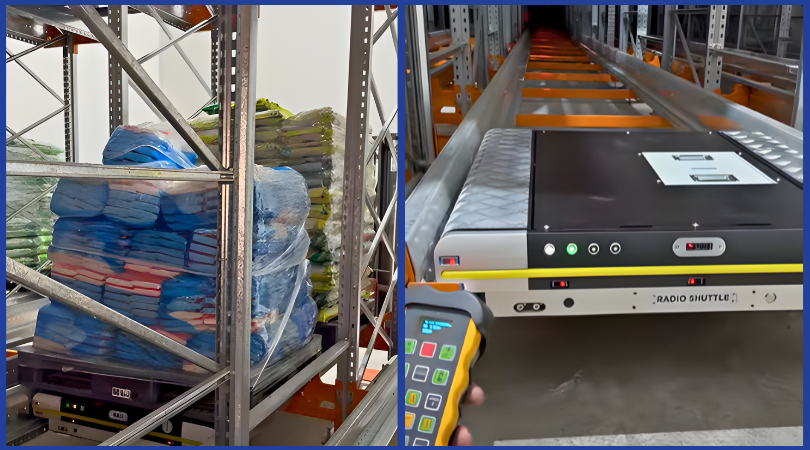
Unlocking Cubic Space: How Pallet Shuttle Systems Achieve Storage Utilization Up to 90%
In the competitive landscape of modern logistics, the cost of warehouse real estate demands that every available cubic foot of storage space be leveraged for maximum profitability. Traditional selective racking is inherently space-inefficient, often achieving far less than 60% utilization. The answer to this density crisis is 2-Way Pallet Shuttle System, a highly effective, semi-automated deep-lane storage solution engineered to turn wasted air into productive inventory space. This system represents a strategic investment that maximizes density, boosts safety, and delivers a rapid return on investment by fundamentally altering how pallets move within the rack structure.
1- The Geometry of Density: Achieving the 90% Utilization Benchmark
The defining benefit of the Pallet Shuttle System is its ability to transform a low-density, aisle-heavy floor plan into a matrix of high-density storage. This shift is achieved through a deliberate mechanical redesign that eliminates the need for non-productive space.
1.1- Eliminating Aisle Waste for Maximum Footprint
In conventional deep-lane systems like Drive-In racking, forklifts must drive directly into the storage lanes, requiring wide aisles for maneuvering and safety clearances. The 2-Way Pallet Shuttle System uses a self-powered, battery-operated vehicle that runs on rails inside the rack. The forklift operator only places the pallet at the entrance of the designated lane (the “Home” position). The shuttle car then autonomously transports the pallet to the correct location within the rack structure. By performing the deep-lane movement independently, the system eliminates the need for forklift travel within the aisles, drastically compressing the warehouse footprint and reducing the total number of working aisles required.
1.2- The Utilization Metric: From 60% to 90%
This reduction in necessary access space is the core driver behind the system’s remarkable performance. Compared to traditional storage solutions that typically offer closer to 60% capacity, Pallet Shuttle Systems consistently deliver 85% to 90% storage utilization. This unparalleled density is critical for operations managing high-volume, low-mix inventory, such as raw material buffers or large batches of finished goods in the food and beverage industry.
2- Operational Excellence: Safety, Speed, and Flexibility
While density is the primary financial driver, the strategic value of a 2-Way Pallet Shuttle System is cemented by its operational advantages, particularly in safety and inventory control.
2.1- Forklift-Free Lanes: A Safety and Maintenance Dividend
A major operational failure point in traditional deep-storage systems is constant rack damage caused by forklift collisions inside the narrow, high-risk lanes. 2-Way Pallet Shuttle System eliminates this risk entirely, as the operator and the forklift remain outside the rack structure. This minimization of human and machine interaction within the storage area translates directly into:
-
Reduced Racking Damage: Lower maintenance and repair costs for the infrastructure.
-
Enhanced Safety: A dramatic reduction in workplace injury risk for warehouse personnel.
2.2- Inventory Management Flexibility: LIFO and FIFO in Deep-Lane Storage
Unlike many high-density systems that restrict inventory rotation, the modular design of the 2-Way Pallet Shuttle System is fully configurable for key inventory management strategies:
-
LIFO (Last-In, First-Out): This is the most frequent configuration, utilizing a single aisle for both loading and unloading to achieve maximum density. It is ideal for stable products with long shelf lives.
-
FIFO (First-In, First-Out): For inventory requiring strict date control (e.g., pharmaceuticals or perishables), the system can be configured as a drive-through, using a separate aisle for loading and a dedicated aisle for retrieval. This prevents interference and ensures precise rotation.
3- The Financial Strategy: Cost-Effectiveness and Scalability
Investing in the 2-Way Pallet Shuttle System is an economic decision that prioritizes operational expenditure (OpEx) savings over initial capital expenditure (CapEx).
3.1- Quantifying the Labor Reduction and ROI
The system drives its return on investment (ROI), typically targeted for one to three years, primarily through labor substitution. By automating the deep-lane movement of pallets, the system can eliminate up to two-thirds of the manual labor previously required for those specific storage and retrieval tasks. The forklift operator becomes a strategic dispatcher, focusing on transferring pallets, rather than maneuvering deep inside the rack, which directly reduces the number of labor hours needed.
3.2- A Budget-Friendly Gateway to Automation
2-Way Pallet Shuttle System serves as a cost-effective alternative to complex, fully autonomous Automated Storage and Retrieval Systems (AS/RS). Its simpler, semi-automated design results in a lower initial investment and reduced installation costs. Furthermore, the system is highly scalable; when throughput needs to increase, businesses can simply add more shuttle carts to the existing racking infrastructure without major structural changes, future-proofing the initial capital outlay.
4- Intelligent Integration with Warehouse Management Systems (WMS)
The full efficiency of a modern Pallet Shuttle System is unlocked not just by its hardware, but by its software integration.
The shuttle car is operated via remote command (RF or Wi-Fi enabled tablet). Crucially, modern systems are integrated with the Warehouse Management System (WMS) through dedicated modules (e.g., Mecalux’s Easy WMS & Pallet Shuttle Integration). This integration creates a two-way data flow:
-
WMS Instructions: Operators receive step-by-step guidance on depositing and extracting goods via a single screen, streamlining tasks.
-
Real-Time Data: The shuttle provides the WMS with immediate, accurate information on inventory status, location, and battery status, even for deep-lane pallets.
This digital visibility enables WMS software to dynamically optimize the storage layout, automatically assigning locations based on factors like frequency of access and available space. This ensures the system maintains its maximum storage utilization by compacting goods efficiently.
Future-Proofing Your Warehouse Footprint
For businesses focused on maximizing every square and cubic foot of their operation, 2-Way Pallet Shuttle System is the definitive, high-value solution. It balances the high storage density required for modern demands—achieving a proven 85% to 90% utilization—with the cost-effectiveness and flexibility of semi-automation.
By eliminating human error and forklift traffic within the rack, optimizing labor utilization, and providing seamless WMS integration, the shuttle system serves as a scalable, reliable, and intelligent asset for industries ranging from manufacturing to cold storage. Choosing a 2-Way Pallet Shuttle System is not just an equipment upgrade; it is a strategic move to future-proof your warehouse footprint against rising costs and increasing throughput demands.
Stop Wasting Cubic Space.
Ready to see the difference between 60% and 90% utilization on your bottom line? Don't wait to turn empty air into profit. Contact our expert today for a customized, data-driven assessment to calculate your precise ROI and start planning your high-density 2-Way Pallet Shuttle System implementation.